Split-Night Sleep Study
Diagnose Sleep apnea and begin CPAP therapy titration in one monitored night, instead of booking two separate studies.
How one night does two jobs
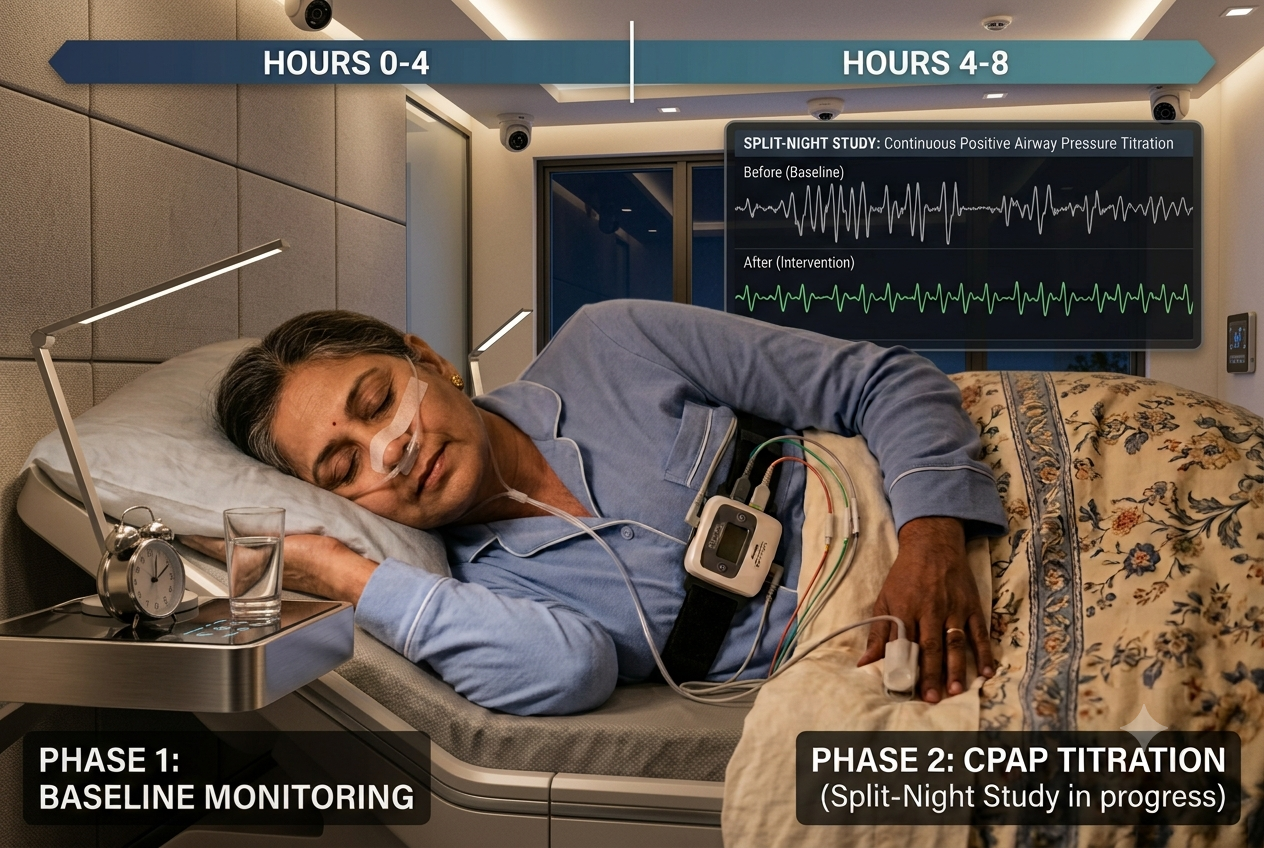
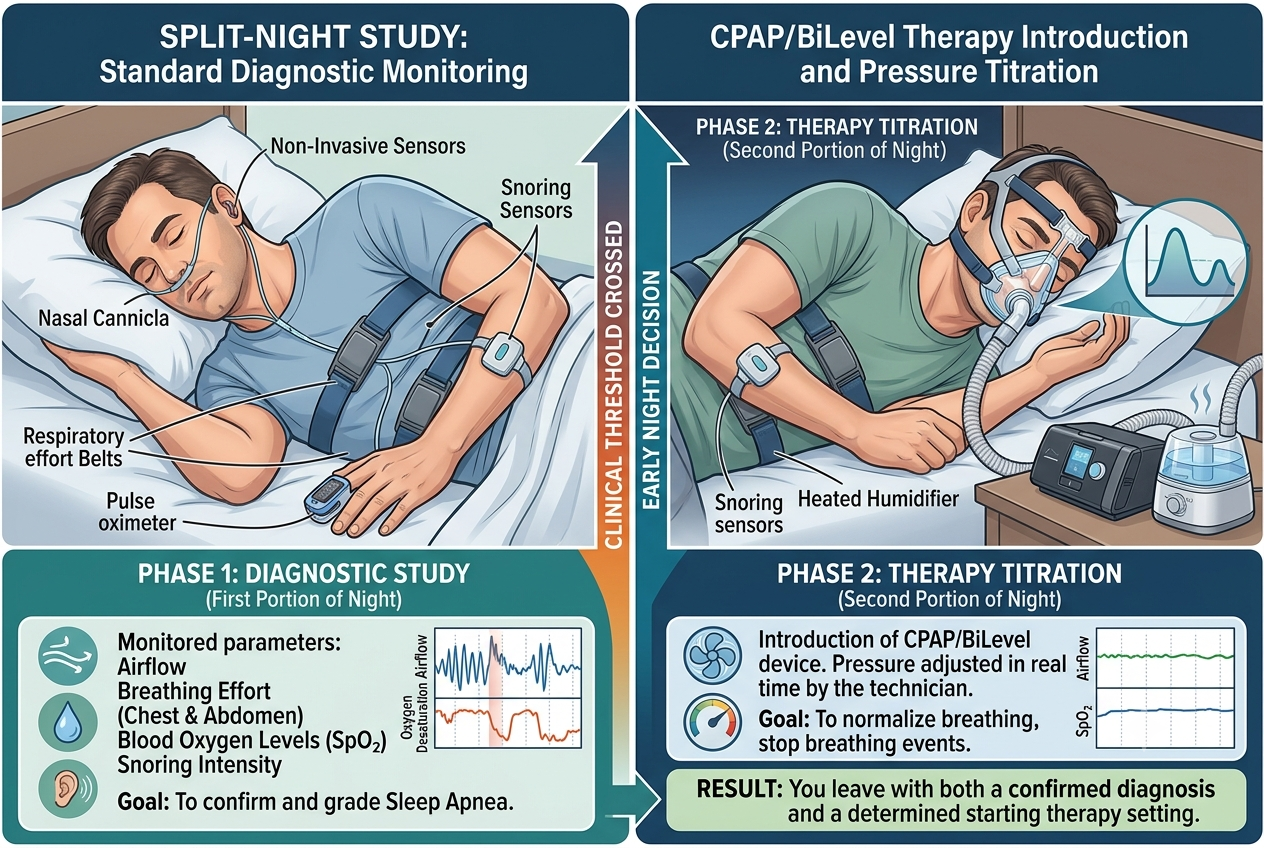
A split-night study divides your monitored sleep into two phases. The first portion of the night runs as a standard diagnostic study — measuring airflow, effort, oxygen, and snoring to confirm and grade Sleep apnea.
If your breathing events cross a clinical threshold early enough in the night, the second portion switches to therapy: a CPAP or BiLevel device is introduced and its pressure adjusted in real time until your breathing normalizes — so you leave with both a diagnosis and a starting therapy setting.
Already diagnosed?
Rent a CPAP or BiPAP Machine — No Big Upfront Cost
Flexible monthly rentals with free delivery, setup, and ongoing support, so you can start therapy right away.
Is a split-night study right for you?
Strong apnea signs already
A prior screening test, or clear symptoms like witnessed breathing pauses, point to moderate-to-severe Sleep apnea.
Fewer test nights
You'd rather combine diagnosis and treatment setup into a single night than schedule two separate studies.
Ready to start therapy
You've decided that if apnea is confirmed, you want to begin CPAP therapy as soon as possible.
Physician-recommended
Your doctor or a prior report has specifically suggested a combined diagnostic-and-titration study.
1-Minute Sleep Quiz
Answer a few quick questions to see whether a sleep test could be worth exploring. This is not a diagnosis.
How the night unfolds
Diagnostic monitoring
The first portion of the night records breathing, effort, oxygen, and snoring as a standard diagnostic study.
Live physician review
If breathing events are frequent enough, the case qualifies to switch into the treatment phase before the night ends.
CPAP titration begins
Therapy pressure is introduced and adjusted through the rest of the night to find the setting that controls your breathing.
Report & next steps
You receive both your diagnostic results and a starting therapy pressure, reviewed by a sleep physician.
A before-and-after snapshot
An illustrative example of how the two phases of a report typically compare — your actual numbers will differ.
| Metric | Diagnostic phase | With Therapy |
|---|---|---|
| Apnea-Hypopnea Index (AHI) | high | low |
| Oxygen Desaturation Index | elevated | near normal |
| Lowest SpO₂ | notably low | stable |
| Snoring | frequent, loud | minimal |
| Sleep arousals | frequent | reduced |
Already diagnosed?
Rent a CPAP or BiPAP Machine — No Big Upfront Cost
Flexible monthly rentals with free delivery, setup, and ongoing support, so you can start therapy right away.
Split-night vs. two-night study
| Feature | Two-night study | Split-night study |
|---|---|---|
| Nights required | 2 separate nights | 1 night |
| Report timeline | Longer — two studies to score | 3–5 days |
| Total cost | Higher | Lower |
| Scheduling | Two separate bookings | One booking |
| Therapy start | Delayed until second study | Same night, if eligible |
Split-night study questions
A split-night study is an overnight sleep test that combines diagnosis and treatment in a single night. Sensors monitor your sleep, breathing, oxygen levels, and heart rate during the first portion to diagnose Sleep apnea; if your breathing events cross a clinical threshold, CPAP therapy is introduced during the second portion to find your appropriate treatment pressure.
It's performed in a single overnight session — the first portion focuses on diagnosing Sleep apnea, and the remaining portion is used for CPAP titration if you meet the required criteria.
A split-night study combines diagnosis and CPAP titration into one night. A full-night diagnostic study only identifies sleep disorders — if treatment is needed afterward, CPAP titration is then done as a separate night.
A Titration Study assumes you already have a confirmed diagnosis and only tests therapy pressure. A split-night study is for people who haven't been diagnosed yet but want diagnosis and treatment setup handled together.
Yes — the same recognized diagnostic standards and comprehensive polysomnography equipment apply to both phases, so the difference is convenience and speed, not data quality. That said, a single night doesn't always leave enough time for both diagnosis and CPAP titration, in which case a separate Titration Study may be recommended.
If your breathing events aren't frequent enough early in the night to justify switching phases — or the care team determines CPAP titration isn't appropriate yet — the study simply continues as a full diagnostic recording. You still get a complete, physician-reviewed diagnosis, and a separate Titration Study can be booked afterward if needed.
If there isn't enough diagnostic data, or not enough time remaining in the night to also complete CPAP titration, your doctor may recommend finishing the evaluation with a separate diagnostic or Titration Study.
Most people adjust within the first night. You'll sleep with several sensors attached and may wear a CPAP mask during the treatment portion — we include mask-fit guidance beforehand, and the pressure is introduced gradually rather than at full strength immediately.
Yes — our take-home kit includes both the diagnostic sensors and a CPAP unit with setup instructions for the therapy phase, so there's no need to stay overnight at a separate sleep center.
A sleep physician reviews the recorded data from both phases and prepares your report. If CPAP titration was completed, the results help determine your starting treatment pressure; if the study is inconclusive, additional testing may be recommended.
What early users are saying
Illustrative feedback shared for demonstration purposes.
Related studies
Home Sleep Apnea Test (HSAT)
Not sure you have apnea yet? Start with the screening-level test first.
Titration Study
Already diagnosed but need therapy pressure fine-tuned on its own? This is the dedicated study.
Polysomnography at Home
Want full sleep-stage data alongside your diagnosis? Consider our comprehensive home PSG.