Understand your sleep, from symptoms to solutions
The common sleep disorders behind poor sleep, the warning signs worth taking seriously, how a home sleep study finds out what's actually going on, and the everyday habits that help protect the sleep you already have.
- Physician-reviewed reports
- Sanitized, single-use sensors
- Results in 3–5 days
Common sleep disorders
Poor sleep isn't always just "being tired." These are the conditions we test for most often.
Obstructive Sleep Apnea
The most common sleep disorder. Throat muscles relax too much during sleep, repeatedly narrowing or blocking the airway — showing up as loud snoring, gasping, and daytime fatigue.
Insomnia
Trouble falling asleep, staying asleep, or waking up too early, often with no single obvious cause. Persistent insomnia can also be a symptom of an underlying breathing or movement disorder.
Narcolepsy
A neurological condition where the brain struggles to regulate sleep-wake cycles, causing sudden daytime sleep attacks and, in some cases, cataplexy or sleep paralysis.
Parasomnias
Disruptive behaviors during sleep — sleepwalking, night terrors, or acting out dreams — that standard sensors alone often can't tell apart from other conditions.
So how do you find out which one it is?
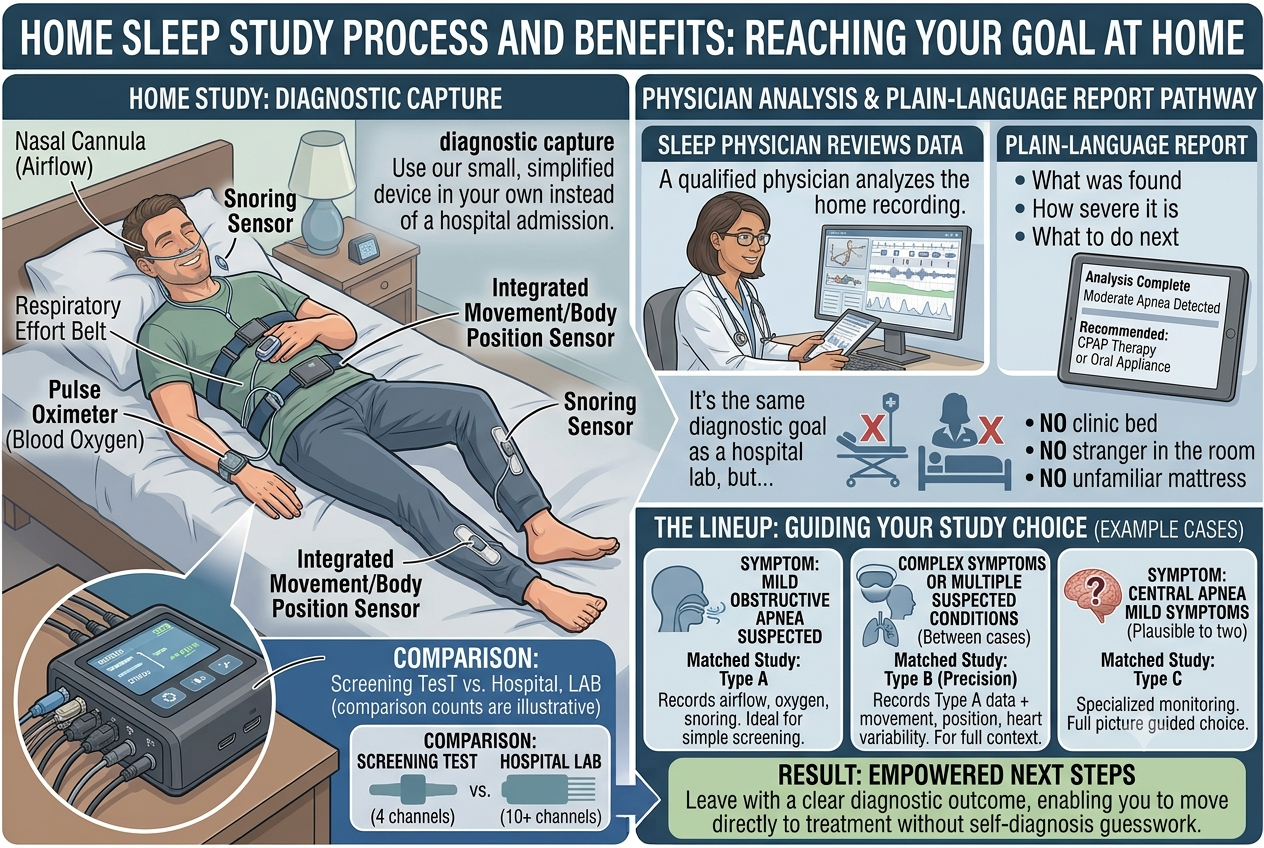
You don't have to self-diagnose from a list of symptoms. A home sleep study is an overnight diagnostic test you take in your own bed, using a small take-home device instead of an overnight hospital admission. Depending on the study, it records some combination of airflow, breathing effort, blood oxygen, heart rhythm, snoring, and body movement while you sleep.
A qualified sleep physician then reviews the recording and turns it into a plain-language report — what was found, how severe it is, and what to do next. It's the same diagnostic goal as a hospital sleep lab, reached without a clinic bed, a stranger in the room, or an unfamiliar mattress working against you.
Most people are simply matched to one study based on their symptoms. The lineup below exists for the cases in between — where two studies could plausibly apply, or where it helps to see the full picture before booking.
Already diagnosed?
Rent a CPAP or BiPAP Machine — No Big Upfront Cost
Flexible monthly rentals with free delivery, setup, and ongoing support, so you can start therapy right away.
The full test lineup
Matched to the disorders above, here are the six studies we offer and the specific question each one is built to answer — tap any card for the full breakdown.
Home Sleep Apnea Test (HSAT)
Answers: "Do I have obstructive Sleep apnea?" A screening-level overnight test for snoring, gasping, or daytime fatigue — the standard first step for most people.
Polysomnography at Home
Answers: "What's the fuller picture?" Our most comprehensive study — breathing, oxygen, heart rhythm, and sleep-stage data in a single night.
Split-Night Study
Answers: "Can diagnosis and treatment happen in one night?" Confirms Sleep apnea and starts CPAP titration in a single monitored session.
Titration Study
Answers: "What's my correct therapy pressure?" For patients already diagnosed, this finds the CPAP or BiLevel setting that works.
Parasomnia Study
Answers: "What's actually happening during sleepwalking, night terrors, or acting out dreams?" A video-assisted study that captures the behavior itself.
Narcolepsy Evaluation
Answers: "Why am I falling asleep during the day?" An overnight PSG plus a next-day nap study (MSLT) to assess excessive daytime sleepiness.
1-Minute Sleep Quiz
Answer a few quick questions to see whether a sleep test could be worth exploring. This is not a diagnosis.
Home test vs. hospital sleep lab
Both reach the same diagnosis — a qualified sleep physician reviews either one. What actually differs is comfort, cost, and how long you wait. This is a general comparison; specific studies vary, so check each test's own page for the details that apply to it.
| Factor | At home with SleepHealth360.com | Traditional hospital lab |
|---|---|---|
| Where you sleep | Your own bed | Unfamiliar clinic room, wired to wall equipment |
| Booking to test night | Often within days | Frequently weeks, depending on lab availability |
| Who's in the room | Just you | A technician monitoring overnight |
| Report review | Qualified sleep physician | Qualified sleep physician |
| Typical cost | Lower | Higher, plus facility fees |
| Best suited for | Screening and most diagnostic studies | Complex cases needing continuous technician oversight |
Healthy sleep habits
Testing finds what's wrong when something is. These everyday habits help protect the sleep you already have.
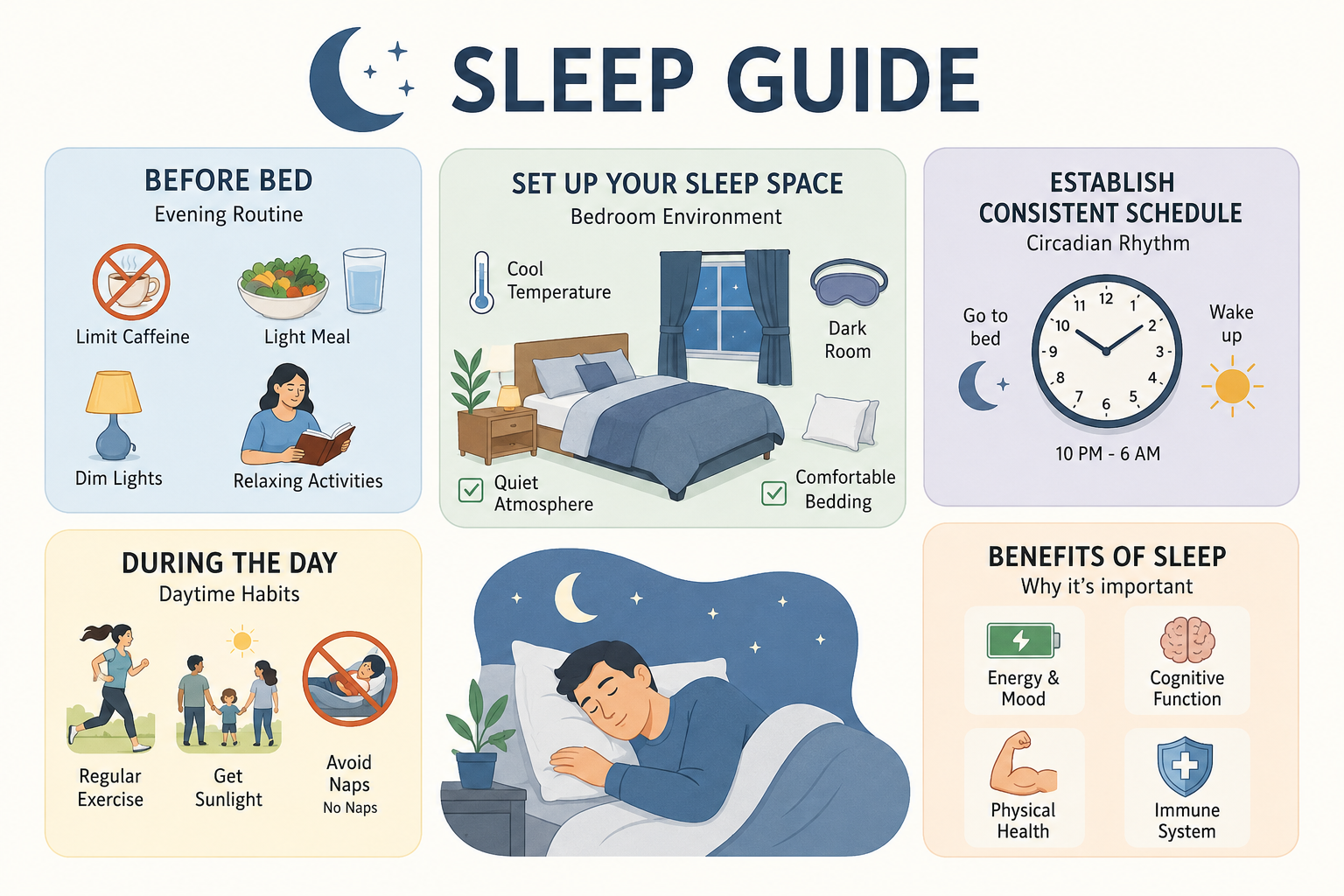
Keep a consistent schedule
Go to bed and wake up at the same time every day, even on weekends, to reinforce your body's natural sleep-wake rhythm.
Watch your evening intake
Limit caffeine and alcohol in the hours before bed — both fragment sleep even when they don't feel like they're keeping you awake.
Build a wind-down routine
Dim the lights and step away from screens 30–60 minutes before bed, so your body gets a clear signal that it's time to sleep.
Keep the bedroom for sleep
A cool, dark, quiet room — reserved mainly for sleep — helps your brain associate the space with rest rather than wakefulness.
Common questions
Most adults need 7–9 hours of quality sleep a night. Consistently getting less than that, or still feeling exhausted despite a full night, is one of the signals worth investigating with a sleep study rather than just pushing through it.
Not always, but loud, frequent snoring combined with witnessed breathing pauses, gasping, or daytime sleepiness is a strong enough signal that testing is worth it. The Home Sleep Apnea Test is the fastest way to get a clear answer.
If you haven't been tested before and your main concerns are snoring, gasping, or daytime fatigue, the Home Sleep Apnea Test is the standard starting point. It's the fastest, lowest-cost way to get a physician-reviewed answer, and your report will tell you if a more specialized study is worth exploring next.
For most suspected breathing-related sleep disorders, yes — with proper setup and physician scoring, a home study is a reliable diagnostic tool. A few evaluations, like narcolepsy's daytime nap test, still need lab-based equipment for part of the process; that's explained on the relevant test's page.
If you've tried the basics — a consistent schedule, less evening caffeine, a proper wind-down routine — and still wake up unrefreshed, snore loudly, gasp for air, or fall asleep unintentionally during the day, that points to a diagnosable disorder rather than a habits problem.
Not always. Many people self-refer for an initial screening test. If your results point to something more specific, our care team will help you work out whether a physician consultation or a specialist study is the right next step.
They're deliberately lightweight and designed to be as unobtrusive as possible. Most people notice them for the first few minutes, then fall asleep and sleep through the night much as they normally would.
Each study maps to one of our Lite, Pro, or Precision tiers, depending on how much data it captures. Every test's page recommends the tier it needs, and our pricing page breaks down exactly what each tier includes.
You'll receive a plain-language report reviewed by a qualified sleep physician, explaining what was found and what it means. Pro and Precision tiers also include a consultation call to walk through the findings and discuss next steps, including treatment if a disorder is confirmed.
What early users are saying
Illustrative feedback shared for demonstration purposes.