Frequently asked questions
Everything you need to know before requesting a SleepHealth360.com test. Can't find your answer? Contact us.
General FAQs
Is a home sleep test as reliable as a hospital study?
For most suspected cases of obstructive Sleep apnea, home testing captures the key signals needed for a physician to make an assessment. More complex cases may be referred for an in-lab study.
How do I use the device?
Every kit ships with simple illustrated instructions. Most sensors are worn on a finger and around the chest or nose — setup typically takes under 10 minutes.
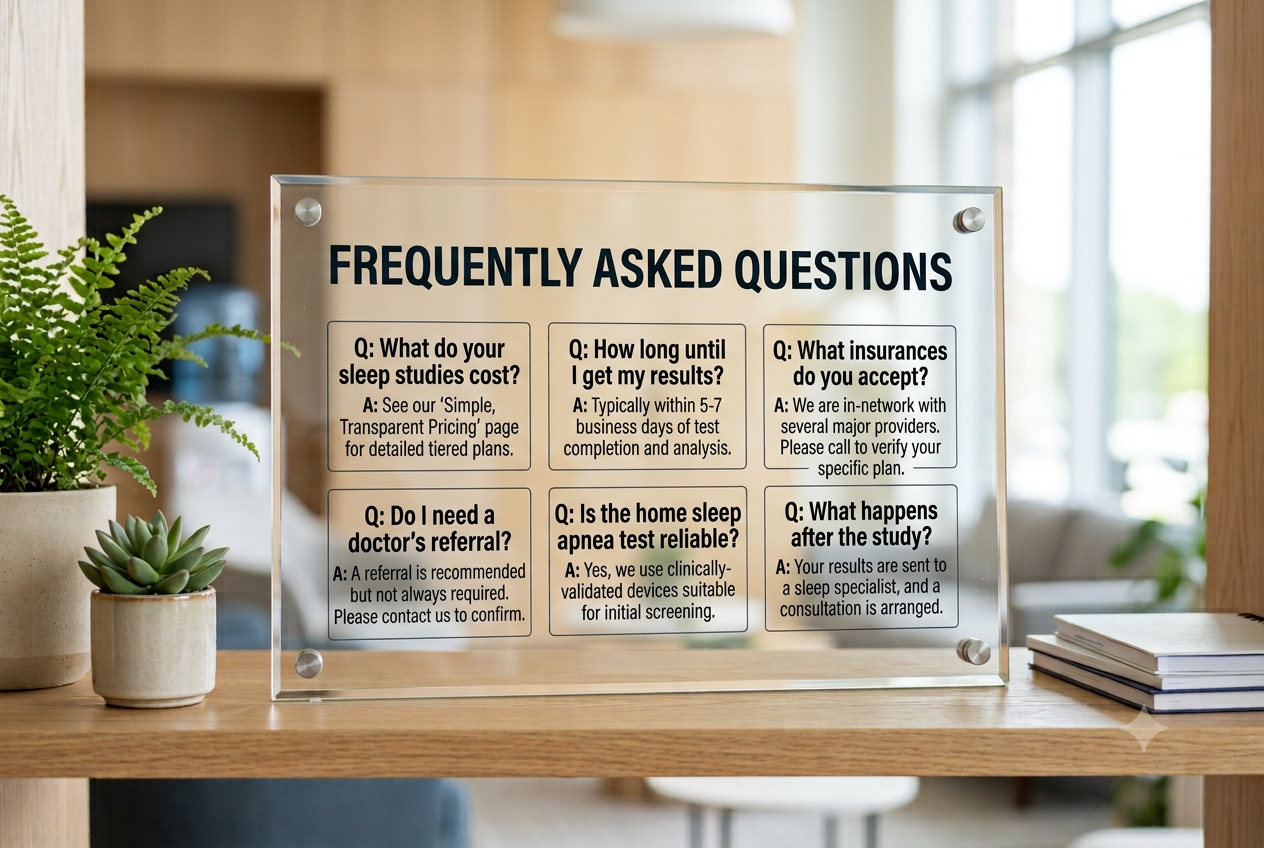
How long until I get results?
Turnaround depends on which test you book — most results are ready in 2–5 days, and some tests offer priority 24–48 hour scoring. See pricing for the exact turnaround per test.
What happens after I get my report?
Your report includes a plain-language summary plus clinical detail. Several of our tests include a consultation call to walk through next steps.
Is the equipment sanitized?
Yes — sensors that touch the skin are single-use or sanitized to clinical standards before every dispatch.
Do I need a doctor's referral to book a test?
No referral is required to book. If your report suggests further evaluation or treatment, we'll help connect you with a partner physician.
What areas do you currently ship to?
We currently serve major metro and tier-2 cities across India, with courier pickup and drop-off for the return kit included with every test.
Can children use SleepHealth360.com's home tests?
Our current kits are designed and validated for adult use. For pediatric sleep concerns, please contact our care team for in-lab referral options.
Home Sleep Apnea Test FAQs
Is snoring alone a reason to get tested?
Snoring by itself doesn't always mean Sleep apnea, but loud, frequent snoring combined with witnessed breathing pauses, gasping, or daytime sleepiness is a strong enough signal that testing is worth it.
Will the sensors be uncomfortable?
The kit uses a soft nasal cannula, a finger clip, and a chest band — no needles, no scalp electrodes. Most people notice the sensors for the first few minutes and then fall asleep normally.
Can I do a Sleep apnea test at home, and how does it work?
Yes. A Home Sleep Apnea Test (HSAT) lets you test for obstructive Sleep apnea from the comfort of your own home while you sleep in your normal environment. You wear a small device overnight that monitors breathing, airflow, blood oxygen levels, heart rate, and breathing effort to identify signs of Sleep apnea.
How accurate is a home test compared to an in-lab sleep study?
For screening-level obstructive Sleep apnea, a properly set up and physician-scored home test is a reliable diagnostic tool, particularly for patients with a high likelihood of moderate-to-severe Sleep apnea. Neither option is universally "better" — home testing is more convenient and often less expensive, while an in-lab study provides more comprehensive monitoring for complex or ambiguous cases.
What if my test comes back negative but I still have symptoms?
A negative or inconclusive home test doesn't completely rule out Sleep apnea. If you continue to experience loud snoring, breathing pauses, choking or gasping during sleep, or excessive daytime sleepiness, speak with your doctor — further evaluation or an in-lab sleep study may be recommended.
What if the test comes back positive?
Your report will explain the severity and recommended next step. Treatment isn't automatically a CPAP machine — it depends on the severity of your Sleep apnea, your symptoms, and your overall health, and may include a Titration Study to find your ideal CPAP pressure, other therapy options, or a referral to a partner physician for a treatment consultation.
Do I need a doctor's referral first?
No — most people book this test directly as a first-time screening. If you already have a diagnosis and need therapy adjusted, our Titration Study is the better fit.
How long does the test itself take?
The test is performed overnight while you sleep normally in your own bed — there's no extended monitoring period or clinic visit required, just a single night wearing the sensors.
Can I use my phone or smartwatch to test for Sleep apnea instead?
Smartwatches and sleep-tracking apps may flag signs that suggest a risk of Sleep apnea, but they're not a substitute for a medically supervised sleep test and professional diagnosis.
What happens after I complete the test, and how long until I get results?
Pack the device into the prepaid return kit; once we receive it, a qualified sleep physician reviews and scores the recording. Results are typically ready in 2-3 days — some other tests are scored on faster turnaround times, see pricing for details.
Polysomnography at Home FAQs
Is this the same as a hospital polysomnography?
It captures a broader dataset than our screening test and is reviewed with the same clinical rigor, though hospital PSG with full scalp EEG electrodes remains the gold standard for the most complex cases, which your physician may still recommend in specific situations.
Is Polysomnography at Home accurate?
Accuracy depends on the equipment used, the signals recorded, correct sensor placement, and the condition being evaluated. Home-based testing is well suited to many patients and conditions, but an in-lab polysomnography may still be recommended when more comprehensive monitoring is required.
How is sleep stage estimated without EEG electrodes?
We combine heart-rate variability, movement, and body position data to model sleep-stage patterns — a well-established approach for home studies, though it's an estimation rather than the direct brain-wave measurement used in a hospital lab.
Should I get this instead of the basic screening test?
If you haven't been tested before and have straightforward symptoms, the Home Sleep Apnea Test is usually enough and more affordable — it uses fewer sensors and is designed primarily to evaluate obstructive Sleep apnea. Polysomnography at Home collects a broader range of sleep-related signals and is better suited to complex, borderline, or multi-symptom cases.
Does this diagnose anything beyond Sleep apnea?
Depending on the type of home monitoring used, the broader dataset can also help identify periodic limb movement disorder, hidden causes behind insomnia, and general sleep fragmentation, alongside standard breathing-related conditions. The appropriate test depends on your symptoms and what your doctor is trying to diagnose.
Is Home Polysomnography better than an in-lab sleep study?
Neither is universally better. Home testing offers greater comfort and convenience, while an in-lab sleep study provides more comprehensive monitoring under professional supervision. Your sleep specialist will recommend the most appropriate option based on your individual needs.
How long does the test itself take?
It's generally performed overnight while you sleep at home. Setup takes some time before bedtime, and the recorded data is reviewed once the test is completed.
Is Home Polysomnography uncomfortable?
It's generally painless, although wearing multiple sensors and wires may feel unusual at first. Since you sleep in your own bed, many people find it more comfortable than spending a night in a sleep laboratory.
What happens if the results are unclear?
If the recording doesn't provide enough information, or the results don't explain your symptoms, your doctor may recommend repeating the test or undergoing a comprehensive in-lab polysomnography for a more detailed evaluation.
How long until I get results, and what happens after the test?
This study is scored on a priority basis, typically within 24–48 hours. A qualified sleep professional analyzes the recorded data and prepares a report for your healthcare provider, who will discuss the findings with you and recommend appropriate next steps — including a consultation call to walk through your report.
Split-Night Study FAQs
What is a Split-Night Sleep Study, and how does it work?
A split-night study is an overnight sleep test that combines diagnosis and treatment in a single night. Sensors monitor your sleep, breathing, oxygen levels, and heart rate during the first portion to diagnose Sleep apnea; if your breathing events cross a clinical threshold, CPAP therapy is introduced during the second portion to find your appropriate treatment pressure.
How long does a Split-Night Sleep Study take?
It's performed in a single overnight session — the first portion focuses on diagnosing Sleep apnea, and the remaining portion is used for CPAP titration if you meet the required criteria.
What is the difference between a split-night study and a full-night diagnostic study?
A split-night study combines diagnosis and CPAP titration into one night. A full-night diagnostic study only identifies sleep disorders — if treatment is needed afterward, CPAP titration is then done as a separate night.
How is this different from a Titration Study?
A Titration Study assumes you already have a confirmed diagnosis and only tests therapy pressure. A split-night study is for people who haven't been diagnosed yet but want diagnosis and treatment setup handled together.
Is a split-night study as accurate as two separate nights?
Yes — the same recognized diagnostic standards and comprehensive polysomnography equipment apply to both phases, so the difference is convenience and speed, not data quality. That said, a single night doesn't always leave enough time for both diagnosis and CPAP titration, in which case a separate Titration Study may be recommended.
What if I don't qualify to switch to therapy mid-study?
If your breathing events aren't frequent enough early in the night to justify switching phases — or the care team determines CPAP titration isn't appropriate yet — the study simply continues as a full diagnostic recording. You still get a complete, physician-reviewed diagnosis, and a separate Titration Study can be booked afterward if needed.
What happens if there isn't enough time to complete both parts of the study?
If there isn't enough diagnostic data, or not enough time remaining in the night to also complete CPAP titration, your doctor may recommend finishing the evaluation with a separate diagnostic or Titration Study.
Is a split-night study uncomfortable?
Most people adjust within the first night. You'll sleep with several sensors attached and may wear a CPAP mask during the treatment portion — we include mask-fit guidance beforehand, and the pressure is introduced gradually rather than at full strength immediately.
Can this be done at home?
Yes — our take-home kit includes both the diagnostic sensors and a CPAP unit with setup instructions for the therapy phase, so there's no need to stay overnight at a separate sleep center.
What happens after a Split-Night Sleep Study?
A sleep physician reviews the recorded data from both phases and prepares your report. If CPAP titration was completed, the results help determine your starting treatment pressure; if the study is inconclusive, additional testing may be recommended.
Titration Study FAQs
Do I need a diagnosis before booking this test?
Yes — a titration study assumes Sleep apnea has already been confirmed, typically through a Home Sleep Apnea Test, Polysomnography, or a Split-Night Study. A diagnostic study determines whether you have a sleep disorder in the first place; a titration study is done afterward purely to find the right PAP pressure. If you haven't been diagnosed yet, start there first.
How long does a Titration Sleep Study take?
It's performed in a single overnight session. The exact duration depends on how quickly your sleep physician can identify the appropriate pressure and whether additional adjustments are needed during the night.
Can this be combined with diagnosis in one night?
Yes — if you haven't been diagnosed yet, our Split-Night Study combines diagnosis and titration into a single night instead of two separate visits.
Will I wear a CPAP mask during the study?
Yes — you'll typically wear a CPAP or other PAP mask while sleeping. Pressure starts low and increases gradually as the technician monitors your breathing and adjusts settings through the night.
Is a Titration Study uncomfortable?
Most people tolerate it well. The mask may feel unusual at first, but the sleep technician can help adjust the fit and settings throughout the night, and we provide mask-fit guidance beforehand to help you get comfortable before pressure ramps up.
What happens during a CPAP Titration Study?
You'll sleep with monitoring sensors attached to your body while wearing a PAP mask. The technician tracks your breathing, oxygen levels, snoring, and other signals throughout the night, adjusting the pressure in small steps to find the most effective setting.
How often should re-titration be done?
There's no fixed schedule, but it's worth considering after significant weight change, if symptoms return despite using therapy consistently, or if your current settings were never formally confirmed.
What if the CPAP pressure isn't determined during the study?
If the night doesn't provide enough information to confirm an effective pressure, your doctor may recommend a repeat titration study, an alternative titration approach, or additional evaluation.
Can a Titration Study determine whether I need CPAP or BiLevel?
The study helps determine the appropriate therapy type and settings based on your breathing patterns and how you respond to pressure. Your sleep specialist makes the final treatment recommendation based on the results and your overall condition.
What happens after a Titration Sleep Study?
A sleep specialist reviews your results and confirms the recommended PAP therapy and settings. Your report includes the confirmed pressure, which can be programmed into your own CPAP or BiLevel device, or used when arranging one through a supplier of your choice.
Narcolepsy Evaluation FAQs
Can the whole evaluation be done at home?
The overnight PSG can be done at home. The next-day MSLT nap study requires lab-based EEG equipment and a controlled environment, so that portion takes place at a partner sleep lab immediately afterward.
Why do I need the overnight study before the MSLT?
An overnight polysomnography (PSG) is generally performed before the MSLT to confirm you had adequate sleep and to rule out other causes of your daytime sleepiness, like undiagnosed obstructive Sleep apnea disrupting your sleep. The MSLT is only meaningful once that's ruled out.
Is narcolepsy curable?
There's currently no cure, but effective treatments and lifestyle strategies can manage symptoms well once a diagnosis is confirmed.
How long does the whole evaluation take?
The PSG is one overnight study; the MSLT the following day typically takes 6–8 hours including nap opportunities and breaks in between — so you'll generally spend one night at a sleep center and remain there for several hours the next day.
Is it safe to drive myself to the nap study?
Given the nature of the symptoms being evaluated, we recommend arranging a ride to and from the partner clinic rather than driving yourself that day.
How is narcolepsy diagnosed, and what happens during the evaluation?
Diagnosis usually involves a detailed medical and sleep history, an overnight polysomnography (PSG), and a Multiple Sleep Latency Test (MSLT) the following day. During the PSG, your sleep and breathing are monitored overnight; during the MSLT, you're offered several scheduled nap opportunities while sensors measure how quickly you fall asleep and whether you enter REM sleep unusually quickly — the key signal for a narcolepsy diagnosis.
What symptoms may indicate narcolepsy?
Common symptoms include excessive daytime sleepiness, sudden uncontrollable episodes of falling asleep, cataplexy (sudden muscle weakness triggered by emotions), sleep paralysis, and vivid dream-like experiences when falling asleep or waking up.
Is a Narcolepsy Evaluation uncomfortable?
It's generally painless. Small sensors are placed on your scalp, face, and body to monitor brain activity, eye movements, muscle activity, heart rate, and other sleep signals — they may feel unusual but shouldn't cause pain.
Can narcolepsy be diagnosed with a blood test or MRI?
Narcolepsy is primarily diagnosed through clinical evaluation and specialized sleep testing rather than a routine blood test or MRI. In certain cases, additional tests such as cerebrospinal fluid hypocretin testing or genetic testing may be considered by a specialist.
What happens after a Narcolepsy Evaluation?
A sleep specialist reviews the overnight and daytime test results along with your symptoms and medical history. If narcolepsy is diagnosed, your doctor will discuss appropriate treatment and strategies to manage daytime sleepiness and other symptoms.
Parasomnia Study FAQs
Why is video necessary, and how is this different from a regular sleep study?
Both a standard sleep study and a parasomnia study use polysomnography to monitor sleep, but many parasomnia events — walking, shouting, acting out a dream — look similar in raw sensor data alone. A parasomnia study adds synchronized infrared video recording, giving the physician the visual context needed to tell these events apart and analyze them accurately.
Does REM Sleep Behavior Disorder always mean something serious?
Not necessarily, but because RBD in older adults can sometimes precede other neurological changes, physicians recommend it be evaluated properly rather than ignored — most people with childhood-onset parasomnias like sleepwalking have nothing similar to worry about.
Will my child outgrow sleepwalking or night terrors?
Many NREM parasomnias in children become less frequent with age. Testing is most useful when episodes are frequent, intense, or raise safety concerns like leaving the bed or house.
Who should undergo a Parasomnia Study?
It may be recommended for people who experience frequent, disruptive, dangerous, or unusual behaviors during sleep, particularly when the cause is unclear or the symptoms could be related to another sleep disorder.
What conditions can a Parasomnia Study detect?
It can help evaluate conditions such as sleepwalking, sleep terrors, REM Sleep Behavior Disorder (RBD), confusional arousals, and other unusual sleep behaviors, as well as identify other sleep disorders that may trigger or mimic parasomnia symptoms. A sleep specialist considers the test results alongside your medical and sleep history to reach a diagnosis.
Is a Parasomnia Study uncomfortable?
It's generally painless. You'll sleep with several sensors attached to your body and may be monitored by video — the equipment can feel unusual at first, but most people can sleep sufficiently for the study.
How long does a Parasomnia Study take?
It's typically performed overnight. You'll set up the sensors and camera in the evening, sleep through the night while being monitored, and the recording wraps up the following morning.
How is video data kept private?
Recordings are used solely for clinical review by your care team and are handled under the same privacy commitments described in our privacy policy.
What if nothing unusual happens on test night?
That's still useful information. If events are infrequent, your care team may suggest a repeat study or a longer monitoring window to improve the odds of capturing one.
What happens after a Parasomnia Study, and how long until I get my report?
A sleep physician reviews the recorded sleep data and video footage together with your symptoms and medical history to identify the likely cause of the nighttime behaviors and determine whether further evaluation or treatment is needed. Video studies take a little longer to score than sensor-only tests — typically a few business days, since a physician reviews the full recording alongside the sensor data.