Home Sleep Apnea Test
An overnight take-home device measures your airflow, breathing effort, and blood oxygen while you sleep in your own bed — scored by a qualified sleep physician, not an algorithm.
What does the test actually measure?
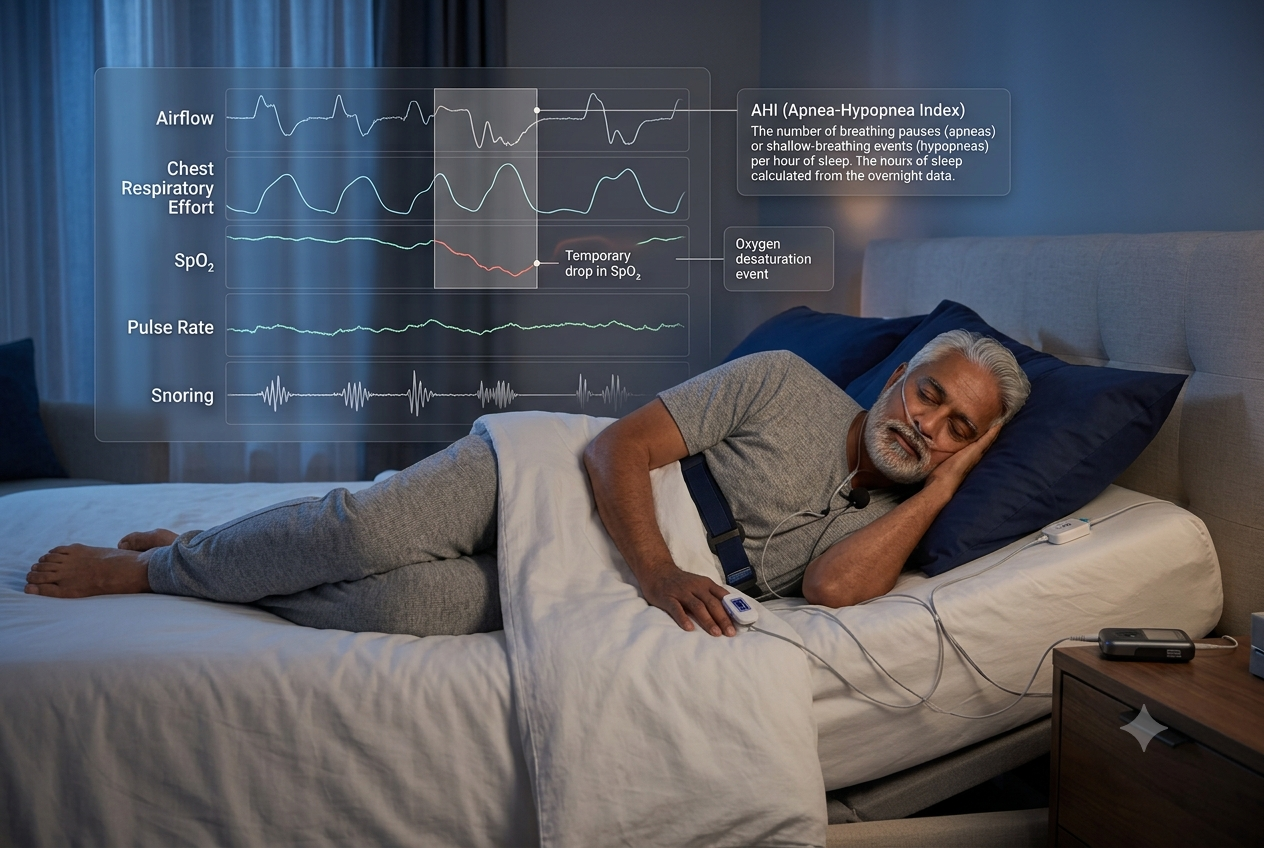
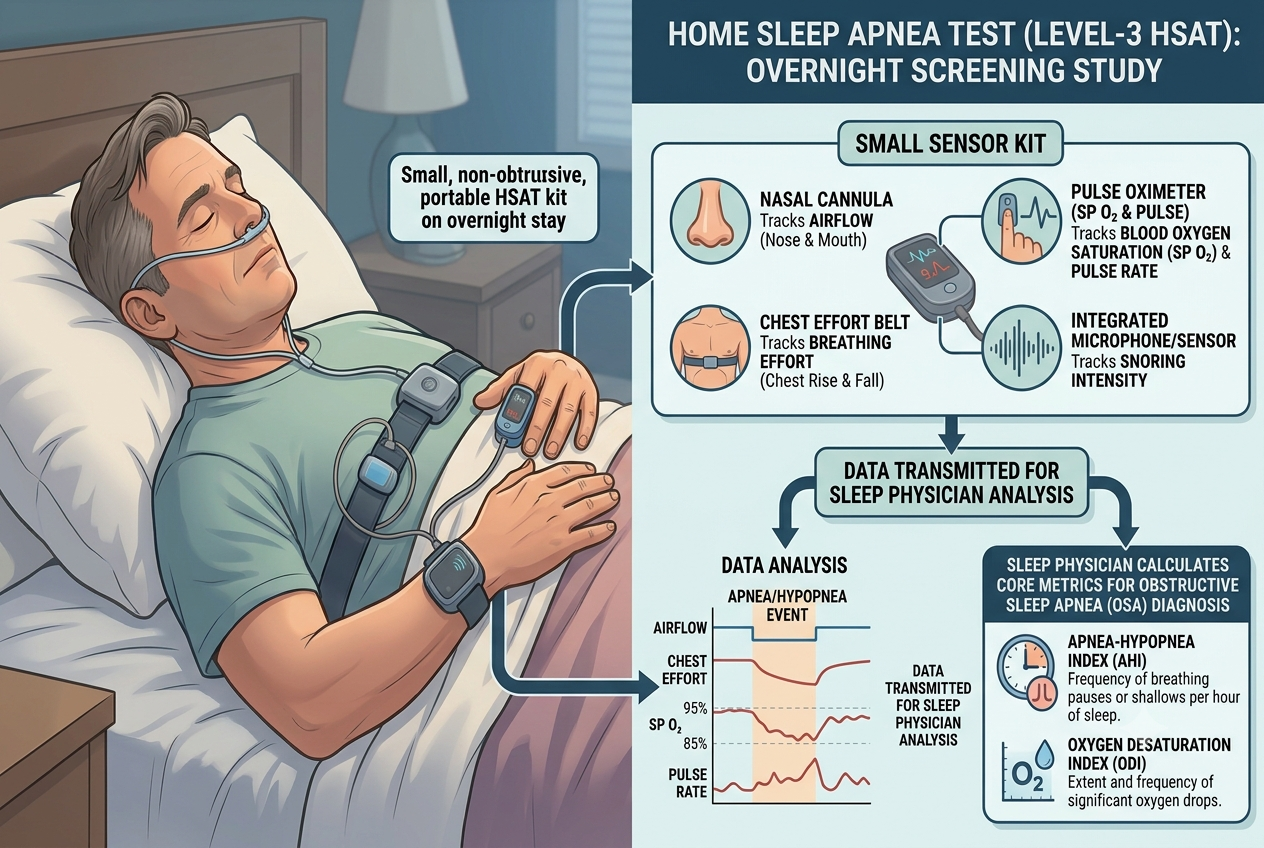
The Home Sleep Apnea Test is a Level-3 style screening study: a small sensor kit worn overnight that tracks airflow through your nose and mouth, the rise and fall of your chest as you breathe, your blood oxygen saturation (SpO₂), pulse rate, and snoring intensity.
That data lets a sleep physician calculate how often your breathing pauses or shallows during the night — the core metric behind an obstructive Sleep apnea diagnosis — and how far your oxygen levels drop when it happens.
Already diagnosed?
Rent a CPAP or BiPAP Machine — No Big Upfront Cost
Flexible monthly rentals with free delivery, setup, and ongoing support, so you can start therapy right away.
Is this the right test for you?
This screening test is the standard starting point if any of the following sound familiar.
Loud snoring or gasping
You snore loudly most nights, or a partner has noticed you choke, gasp, or stop breathing briefly in your sleep.
Daytime sleepiness
You feel groggy, unfocused, or drowsy during the day even after what should have been a full night's sleep.
High blood pressure
You have high or hard-to-control blood pressure — a common downstream sign of unaddressed Sleep apnea.
Other risk factors
Age 40+, higher BMI or neck size, a family history of Sleep apnea, or regular evening alcohol use.
1-Minute Sleep Quiz
Answer a few quick questions to see whether a sleep test could be worth exploring. This is not a diagnosis.
What happens on test night
No clinic visit, no technician in the room — just your normal bedtime routine with a small kit attached.
10-minute setup
Attach the finger, nasal, and chest sensors following the illustrated guide — no gels or scalp wiring involved.
Sleep as usual
Go to bed at your normal time. The device runs quietly in the background for the whole night.
Automatic recording
Airflow, effort, SpO₂, pulse, and snoring are logged continuously while you sleep.
Return & scoring
Pack the device into the prepaid return kit; a sleep physician scores the night and prepares your report.
Already diagnosed?
Rent a CPAP or BiPAP Machine — No Big Upfront Cost
Flexible monthly rentals with free delivery, setup, and ongoing support, so you can start therapy right away.
Sleep apnea test questions
Snoring by itself doesn't always mean Sleep apnea, but loud, frequent snoring combined with witnessed breathing pauses, gasping, or daytime sleepiness is a strong enough signal that testing is worth it.
The kit uses a soft nasal cannula, a finger clip, and a chest band — no needles, no scalp electrodes. Most people notice the sensors for the first few minutes and then fall asleep normally.
Yes. A Home Sleep Apnea Test (HSAT) lets you test for obstructive Sleep apnea from the comfort of your own home while you sleep in your normal environment. You wear a small device overnight that monitors breathing, airflow, blood oxygen levels, heart rate, and breathing effort to identify signs of Sleep apnea.
For screening-level obstructive Sleep apnea, a properly set up and physician-scored home test is a reliable diagnostic tool, particularly for patients with a high likelihood of moderate-to-severe Sleep apnea. Neither option is universally "better" — home testing is more convenient and often less expensive, while an in-lab study provides more comprehensive monitoring for complex or ambiguous cases.
A negative or inconclusive home test doesn't completely rule out Sleep apnea. If you continue to experience loud snoring, breathing pauses, choking or gasping during sleep, or excessive daytime sleepiness, speak with your doctor — further evaluation or an in-lab sleep study may be recommended.
Your report will explain the severity and recommended next step. Treatment isn't automatically a CPAP machine — it depends on the severity of your Sleep apnea, your symptoms, and your overall health, and may include a Titration Study to find your ideal CPAP pressure, other therapy options, or a referral to a partner physician for a treatment consultation.
No — most people book this test directly as a first-time screening. If you already have a diagnosis and need therapy adjusted, our Titration Study is the better fit.
The test is performed overnight while you sleep normally in your own bed — there's no extended monitoring period or clinic visit required, just a single night wearing the sensors.
Smartwatches and sleep-tracking apps may flag signs that suggest a risk of Sleep apnea, but they're not a substitute for a medically supervised sleep test and professional diagnosis.
Pack the device into the prepaid return kit; once we receive it, a qualified sleep physician reviews and scores the recording. Results are typically ready in 2-3 days — some other test plans are scored on faster turnaround times, see pricing for details.
What early users are saying
Illustrative feedback shared for demonstration purposes.
Related studies
Split-Night Study
If your screening suggests moderate-to-severe apnea, this combines diagnosis and therapy titration into one night.
Titration Study
Already diagnosed? This finds your optimal CPAP or BiLevel pressure setting.
Polysomnography at Home
Want a fuller picture beyond screening? Our comprehensive home PSG adds sleep-stage data.