Polysomnography at Home
Our most comprehensive home study — breathing, oxygen, heart rhythm, body position, and sleep-stage data captured in one night, reviewed by a qualified sleep physician.
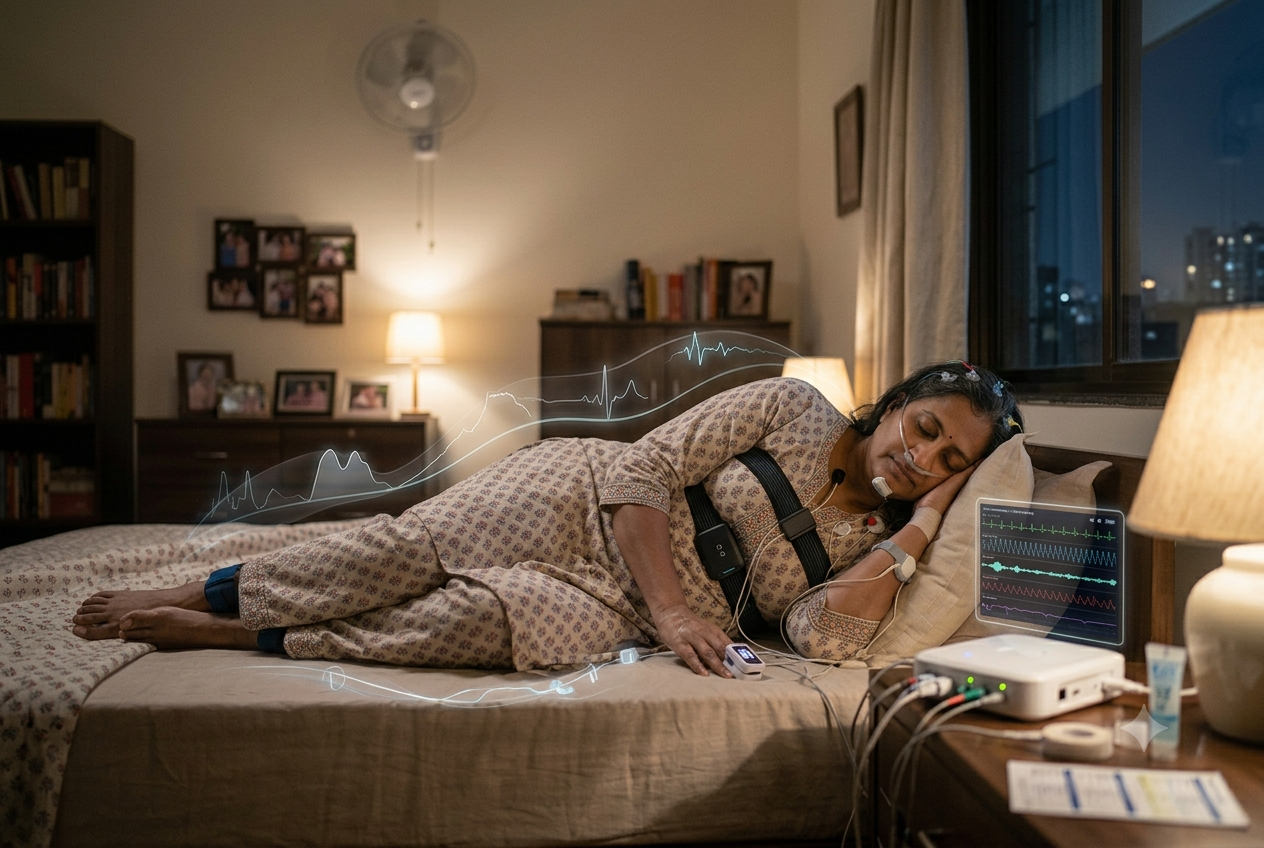

The fullest picture we offer at home
Polysomnography at Home is our most comprehensive home study: alongside the airflow, effort, oxygen, and snoring data captured in our screening test, it adds heart-rate variability, body position, and limb-movement tracking, which a sleep physician uses to estimate your sleep stages and arousal patterns through the night.
It's built for situations where a simple screening test isn't enough — borderline or complex cases, multiple suspected conditions, or when your physician specifically wants a fuller dataset to work from.
Already diagnosed?
Rent a CPAP or BiPAP Machine — No Big Upfront Cost
Flexible monthly rentals with free delivery, setup, and ongoing support, so you can start therapy right away.
Who needs this?
Want more than a screening result
You've had a basic test before, or want the fuller data set from the start rather than testing twice.
Complex or borderline case
Your physician wants a richer dataset because your symptoms don't fit a simple pattern.
Unexplained insomnia
Persistent poor sleep with no obvious cause, where hidden movement or breathing issues may be involved.
Multiple concerns at once
You suspect more than one issue — for example, both snoring and restless, fragmented sleep.
1-Minute Sleep Quiz
Answer a few quick questions to see whether a sleep test could be worth exploring. This is not a diagnosis.
Screening test vs. full home PSG
| What's captured | Home Sleep Apnea Test (HSAT) | Polysomnography at Home |
|---|---|---|
| Airflow & breathing effort | Included | Included |
| Blood oxygen (SpO₂) | Included | Included |
| Heart rate & variability | Basic heart rate | Full variability analysis |
| Body position & limb movement | Not included | Included, detailed |
| Sleep-stage estimation | Not included | Full analysis |
| Turnaround | 2-3 days | 24–48 hours, priority |
| Price | ₹2,499 ₹1,799 | |
| Request At-Home Sleep Apnea Test | Request PSG at Home |
What happens on test night
Guided setup
The expanded sensor kit — chest, finger, and limb sensors — is attached following an illustrated guide.
Full-night recording
Breathing, oxygen, heart rhythm, body position, and movement are recorded continuously overnight.
Priority physician scoring
A sleep physician reviews the full dataset and estimates your sleep-stage pattern and arousals.
Comprehensive report
You receive a detailed report plus a consultation call to walk through the findings and next steps.
Home PSG questions
It captures a broader dataset than our screening test and is reviewed with the same clinical rigor, though hospital PSG with full scalp EEG electrodes remains the gold standard for the most complex cases, which your physician may still recommend in specific situations.
Accuracy depends on the equipment used, the signals recorded, correct sensor placement, and the condition being evaluated. Home-based testing is well suited to many patients and conditions, but an in-lab polysomnography may still be recommended when more comprehensive monitoring is required.
We combine heart-rate variability, movement, and body position data to model sleep-stage patterns — a well-established approach for home studies, though it's an estimation rather than the direct brain-wave measurement used in a hospital lab.
If you haven't been tested before and have straightforward symptoms, the Home Sleep Apnea Test is usually enough and more affordable — it uses fewer sensors and is designed primarily to evaluate obstructive Sleep apnea. Polysomnography at Home collects a broader range of sleep-related signals and is better suited to complex, borderline, or multi-symptom cases.
Depending on the type of home monitoring used, the broader dataset can also help identify periodic limb movement disorder, hidden causes behind insomnia, and general sleep fragmentation, alongside standard breathing-related conditions. The appropriate test depends on your symptoms and what your doctor is trying to diagnose.
Neither is universally better. Home testing offers greater comfort and convenience, while an in-lab sleep study provides more comprehensive monitoring under professional supervision. Your sleep specialist will recommend the most appropriate option based on your individual needs.
It's generally performed overnight while you sleep at home. Setup takes some time before bedtime, and the recorded data is reviewed once the test is completed.
It's generally painless, although wearing multiple sensors and wires may feel unusual at first. Since you sleep in your own bed, many people find it more comfortable than spending a night in a sleep laboratory.
If the recording doesn't provide enough information, or the results don't explain your symptoms, your doctor may recommend repeating the test or undergoing a comprehensive in-lab polysomnography for a more detailed evaluation.
This study is scored on a priority basis, typically within 24–48 hours. A qualified sleep professional analyzes the recorded data and prepares a report for your healthcare provider, who will discuss the findings with you and recommend appropriate next steps — including a consultation call to walk through your report.
What early users are saying
Illustrative feedback shared for demonstration purposes.
Related studies
Home Sleep Apnea Test (HSAT)
First time testing? The screening-level study is a faster, lower-cost starting point.
Split-Night Study
Want diagnosis and CPAP titration handled together in one night instead?
Titration Study
Already diagnosed and just need your therapy pressure confirmed? This is the dedicated study.